Better Hair Starts With a Better Diagnosis
Before we talk about hair transplants, we need to understand why you're losing your hair. A receding hairline, widening part, or thinning crown may be related to genetics, but other medical and scalp conditions can cause similar changes. At FORM Face + Body, a hair transplant clinic in Toronto, our hair restoration program is led by Dr. Michael Brandt, who personally evaluates every patient. We use detailed scalp assessment, trichoscopy, and TrichoLAB 3D imaging to understand your hair loss and determine which treatments are worth considering.
You may benefit from medical treatment, non-surgical support, manual FUE, or ARTAS iXi robotic hair transplantation. Your assessment is where we find the right starting point.

A Physician's Perspective
At FORM Face + Body, Dr. Brandt leads the hair restoration program and personally evaluates every patient. His background in facial plastic and reconstructive surgery shapes how we approach hairline design, donor preservation, and surgical planning. We look at your hair loss as a medical concern first, then consider how treatment can improve your appearance.
Having medical hair care, non-surgical treatments, manual FUE, and ARTAS iXi robotic technology available allows us to recommend different approaches for different patients. Someone with early thinning and healthy active follicles may benefit from medical treatment. Someone with stable, established hair loss may be ready to consider transplantation. We also treat patients who need help correcting a previous transplant.
“We don't start by deciding which treatment to sell. We start by understanding the patient's hair loss.”
— Dr. Michael Brandt
See the Whole Picture
Hair loss isn't always easy to diagnose by looking at it. Two people can have similar thinning but need very different treatments. That's why we begin with a medical history, scalp examination, and a closer look at the health and distribution of your hair.

Trichoscopy uses magnified images of your scalp and follicles to reveal details that aren't easy to see with the naked eye. We can look at differences in hair thickness, signs of follicle miniaturization, and changes in the scalp that may point toward a particular type of hair loss.
TrichoLAB imaging adds another level of detail. Its imaging and analysis tools help us document hair density, examine the distribution of follicles, and compare changes over time. TrichoLAB 3D imaging also gives us a way to assess potential hairline designs and discuss donor supply when transplantation is being considered. These measurements support Dr. Brandt's assessment; they don't replace medical judgment or predict exactly how your hair will change.
Depending on your symptoms and medical history, further investigation may be needed to rule out thyroid problems, nutritional deficiencies, inflammation, or other conditions.
Our Toronto hair restoration approach follows five steps:
The goal is to understand what you're dealing with before committing to a particular treatment.
A Plan for What Comes Next
Hair restoration works best when we consider what you still have as carefully as what you've lost. At FORM Face + Body, we organize treatment around three priorities.
If your follicles are still active, medical hair loss management may help slow further thinning or maintain more of your existing hair. This can be especially valuable when hair loss is still progressing. We want to protect your remaining density before deciding whether surgery would improve the situation.
Some patients benefit from additional non-surgical treatments that support active follicles and the appearance of thinning hair. Options may include platelet-rich plasma (PRP), Alma TED, or other scalp-focused therapies. Their role depends on your diagnosis, and we won't assume that a device or treatment is appropriate for everyone.
When the pattern of hair loss is suitable and enough healthy donor hair is available, transplantation can restore coverage to areas such as the hairline, temples, or crown. We offer both manual FUE and ARTAS iXi robotic FUE. The plan accounts for how your hair looks now and how it may continue to change in the years ahead.
Protect What You Have
Surgery isn't always the best first step. If you have active follicles and a type of hair loss that responds to medical care, we may recommend treatment aimed at maintaining density or slowing further loss.
Our hair health and hair loss treatment options may include topical minoxidil, prescription medications such as finasteride when appropriate, and treatment of an underlying medical or scalp condition. We consider possible side effects, your health history, and your goals before recommending medication.
Hair loss in women can require a different assessment. Hormonal changes, diffuse thinning, increased shedding, and certain inflammatory conditions may all contribute. Our women's hair loss program addresses these differences rather than treating every patient as though they have the same pattern of baldness.
PRP uses a concentrated portion of your own blood platelets, injected into selected areas of the scalp. It may be considered for certain patients with pattern hair loss, often alongside medical treatment. Results vary, and maintenance may be needed.
Other supportive treatments, including scalp care and light-based therapies, may have a role in some plans. We'll explain the purpose of each recommendation and what improvement is realistic.
Alma TED uses ultrasound and air pressure to support the delivery of a topical formula through the scalp without needles or incisions. It may be considered for patients with early or moderate thinning who still have active follicles.
Alma TED can't create new follicles or rebuild an area where hair has already been permanently lost. The response can vary, and several treatments or ongoing maintenance may be recommended. We'll explain whether it fits your diagnosis and how progress will be assessed.
Technology in Experienced Hands
Hair transplantation moves healthy follicles from a donor area, usually at the back and sides of the scalp, to an area where coverage has been lost. At FORM Face + Body, we focus on follicular unit extraction (FUE), which removes small groups of follicles individually rather than taking a strip of scalp. FUE avoids the long linear scar associated with strip surgery, but it still creates small extraction sites that heal with tiny scars. Both the harvesting technique and the placement of the grafts affect the result.
With manual FUE, the harvesting instrument is controlled directly by the operator. This allows adjustments for the angle, direction, curl, and thickness of individual hairs. Manual FUE is useful when the donor area's characteristics call for that flexibility. It can be used to restore a receding hairline, improve selected areas of density, or perform more complex corrective work.
The ARTAS iXi robotic hair restoration system uses digital imaging, software, and robotic guidance to assist with follicular unit extraction. The technology can help identify follicles and carry out repetitive harvesting work while accounting for the distribution of hair in the donor area.
The robot doesn't decide whether you need a transplant or how many grafts should be saved for the future. Dr. Brandt makes those clinical and aesthetic decisions. We offer both manual and robotic FUE because hair characteristics and donor conditions differ from one patient to another.
If you've already had a transplant, the next plan may be more complicated. Our revision hair restoration services address concerns such as unnatural hairlines, poor density, visible scarring, incorrect growth direction, or a depleted donor area.
We'll examine what was done previously and how much usable donor hair remains before recommending further work. Some problems can be improved, but additional grafts cannot always correct extensive donor damage.
The Decisions Behind Every Graft
A hair transplant involves more than moving follicles from one place to another. The way grafts are harvested, protected, and placed affects the result. These decisions also determine how much donor hair remains available if you need further treatment later.
Hair grafts contain living follicles that need careful handling after extraction. Excessive trauma, drying, and unnecessary time outside the scalp can affect their condition. Graft handling and placement are important parts of surgical planning, whether the follicles are harvested manually or with robotic assistance. No technique can guarantee that every transplanted follicle will grow, and there's no universal graft survival rate that applies to every patient.
Your donor supply is limited. Taking too many grafts from one area can leave visible thinning or an uneven appearance at the back of the head. We consider the distribution of your donor hair, the number of grafts needed now, and the possibility of future hair loss before planning extraction.
A good hairline should suit your forehead, facial proportions, age, and existing hair. We look at the angle and direction of each area of growth, the type of hair being placed at the front, and where density will make the most difference.
Dr. Brandt's facial plastic and reconstructive surgery background informs this planning. A hairline should look appropriate as your face and surrounding hair continue to age. Trying to create maximum density or an unusually low hairline today may leave fewer options in the future.
The Right Treatment at the Right Time
To be a candidate for hair restoration Toronto patients typically notice a receding hairline, a thinning crown, a widening part, or gradual loss of density. Some patients can benefit from medical treatment while their follicles remain active. Others may be candidates for a hair transplant if their hair loss pattern is suitable and enough healthy donor hair remains.
Surgery may need to wait if your hair loss is changing quickly or an underlying condition hasn't been addressed. Sudden shedding, patchy loss, scalp pain, inflammation, or scarring may require further medical investigation before restoration is considered.
We also assess your previous treatments and long-term expectations. A transplant can add coverage, but it won't prevent surrounding hair from continuing to thin. During your assessment, Dr. Brandt will explain which options fit your situation and whether treatment should begin now.
The Physician Behind the Plan
Dr. Michael Brandt, MD, MSc, EMBA, FRCSC, Otolaryngology Head and Neck Surgeon, is the clinical lead of the hair restoration program at FORM Face + Body. He is a Royal College-certified Otolaryngology–Head & Neck Surgeon who practices in facial plastic and reconstructive surgery.
His training includes advanced facial plastic and reconstructive surgery, with a focus on anatomy, proportion, and surgical planning. He personally evaluates hair restoration patients and determines how medical treatment, donor preservation, and hairline design should fit into the overall plan.
For Dr. Brandt, the technology is one part of the process. Understanding the patient's hair loss and creating a plan that will still make sense years from now come first.
Results in Perspective
Our hair restoration before-and-after gallery shows results from patients treated at FORM Face + Body, including cases attributed to Dr. Brandt. These examples can help you see how different hairlines, degrees of thinning, and treatment areas affect the final appearance. Results depend on the diagnosis, donor supply, hair characteristics, and treatment performed. Photographs are useful when comparing cases with similar starting conditions, but another patient's result doesn't predict your own.
1 of 9
Progress Over Time
Recovery depends on the treatment. Alma TED usually causes little downtime, while injections may cause temporary scalp tenderness. FUE transplantation requires more care because both the donor and recipient areas need to heal.
After a transplant, our Toronto hair restoration patients may have redness, swelling, tenderness, and small scabs. Many patients return to light daily activities within several days, but visible healing can continue for a week or two, sometimes longer. We'll explain when to wash your scalp, resume exercise, and avoid anything that could disturb newly placed grafts.
Hair growth takes time. Transplanted hair shafts commonly shed in the first few weeks, even when the follicles remain in place. New growth often begins around three to four months, with density developing over the following months. Results are usually assessed around 12 months, and some areas may continue to mature beyond that.
Medical and non-surgical treatments also require patience. Depending on the treatment, visible changes may take several months and may be better evaluated through repeat photographs and scalp measurements.
Transplanted follicles taken from an appropriate donor area can continue growing for many years. However, their growth is not guaranteed forever, and transplantation does not stop your existing hair from thinning.
Long-term follow-up helps us monitor changes, assess your response to medical treatment, and decide whether maintenance or another procedure may be useful. Protecting the hair around a transplant is often just as important as the transplant itself.
Clarity Before Commitment
Hair restoration costs depend on the treatment and how much work is needed. The current FORM Face + Body pricing menu lists FUE transplantation starting at $11,500, ARTAS robotic FUE at $13,500 for up to 2,500 grafts, Alma TED starting at $1,000 per session, and PRP starting at $750 per session. Prices are in Canadian dollars, plus applicable HST.
A hair restoration assessment with Dr. Brandt is $200, which is credited toward treatment. During the assessment, we'll review your diagnosis, discuss the treatments that may help, and explain expected results, recovery, maintenance, and the cost of the recommended plan, including financing options. A Patient Coordinator will help confirm the appointment details.
Your Next Step Starts With Answers
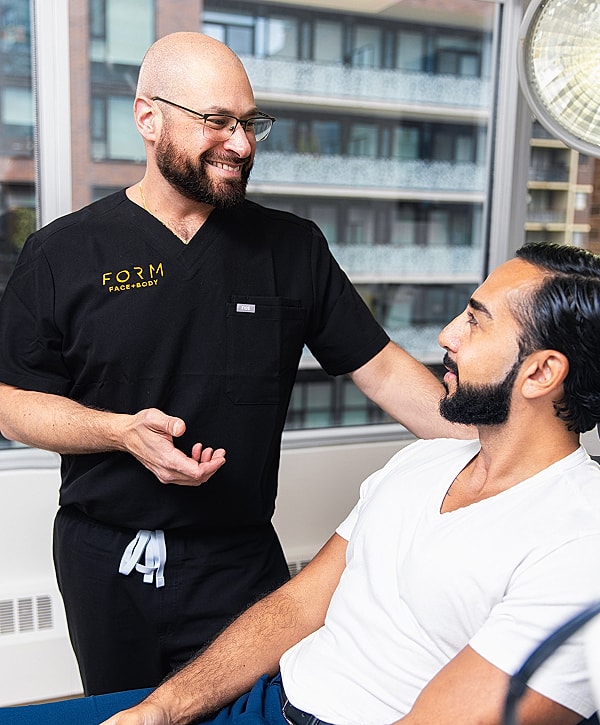
You don't need to decide whether you want a hair transplant before coming to FORM Face + Body. Your first step is an assessment with Dr. Brandt, who will examine your hair and scalp, discuss the possible causes of your hair loss, and help you understand what can be preserved, supported, or restored.
You'll leave with a clearer understanding of your options, what treatment may involve, and the next steps available to you. After you submit your request, a Patient Coordinator will contact you to confirm your appointment and let you know if there is an assessment fee.
That depends on the cause and extent of your hair loss. If follicles are still active, medical treatment or non-surgical support may help preserve or improve existing hair. A transplant may be considered when coverage has been permanently lost and sufficient donor hair is available.
Dr. Brandt will review your hair loss history, examine your scalp, and assess your hair and donor area. Trichoscopy and TrichoLAB imaging help document what is happening. You'll discuss the diagnosis, possible treatments, recovery, maintenance, and costs before choosing the next step.
You generally need enough healthy donor hair, a suitable pattern of loss, and a healthy scalp. Dr. Brandt will also consider your age, medical history, ongoing thinning, and the risk of needing additional treatment in the future.
Both use follicular unit extraction. Manual FUE allows direct adjustment of the harvesting instrument, while ARTAS iXi uses digital imaging and robotic guidance to assist with extraction. Neither is automatically better for every patient. The right choice depends on your hair and donor area.
Natural-looking results depend on hairline shape, graft selection, density, and the direction in which follicles are placed. Dr. Brandt plans these details around your facial proportions and existing hair. Results vary, and no surgeon can guarantee an invisible transplant.
Some forms of hair loss can be slowed or managed with appropriate medical treatment. Others may improve once an underlying cause is treated. Your diagnosis determines what's possible, and continued treatment may be needed to maintain the benefit.
The transplanted hair may continue to grow while the surrounding original hair thins. This can change the appearance of your result over time. Medical management, ongoing assessment, or another procedure may be considered, depending on your donor supply and the degree of further loss.
Sometimes. Revision hair restoration may improve an unnatural hairline, poor density, incorrect hair direction, or certain scars. What can be corrected depends on the earlier procedure, scalp condition, and how much donor hair is still available.