FORM Women's Health
by Élevé

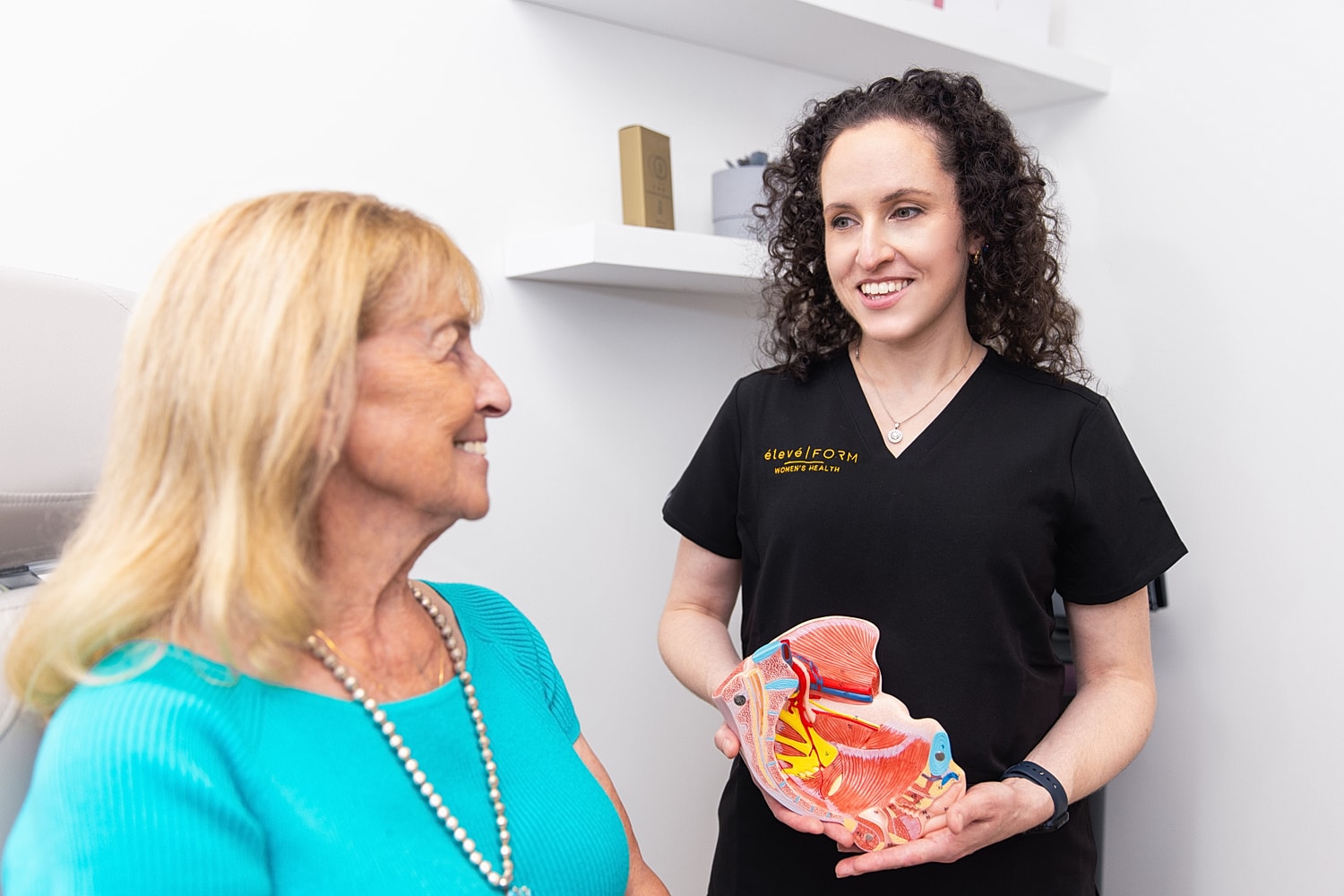
Founded by Fellowship-Trained Urologist Dr. Alaina Garbens (MD, PhD, FRCSC), FORM Women's Health by Élevé is a physician-led, assessment-first women's health clinic focusing on pelvic health, postpartum recovery, menopause support, sexual wellness, urinary and bladder health, and regenerative medicine. Every new patient starts with a comprehensive Women's Health Assessment.
FORM Women's Health by Élevé. Located at Yonge and Eglinton in Midtown Toronto, inside FORM at 90 Eglinton Avenue East, Suite 700. Not covered by OHIP. No referral required.

It is. These are the things we assess together, in one appointment.
Leaking, urgency, painful sex, dryness, recurrent UTIs, pelvic pressure, changes after childbirth, changes in desire: all of these are common. Common describes how many women have them. It says nothing about whether they can change.
Some of what you live with is part of life. A lot of it is not. The difference is that nobody has assessed which is which for you.
That is what we do first.
Dr. Alaina Garbens is a fellowship-trained urologist with a PhD from the University of Toronto. She built Élevé because she kept meeting women whose symptoms sat between specialties, and who had been told to live with them.
Élevé is her clinical model for pelvic, bladder, hormonal and sexual health: assess first, understand what is actually happening, then treat what is there. Your care follows the Élevé Method, created and directed by Dr. Garbens and delivered by the Élevé clinical team.
FORM is a physician-led medical facility in Midtown Toronto. Being inside it means that when your care connects to something else, such as FORM Life+ for diagnostics and longer-term health, or FORM Hair when hair change is part of a hormonal picture, the right clinician is down the hall, not another referral.
Every new patient starts with the Women's Health Assessment. Nothing is recommended, planned or sold before it.
Bladder and pelvic floor · Perimenopause, menopause and Genitourinary Symptoms of Menopause· Postpartum, months or years later · Sexual health · Recurrent UTIs · Core and abdominal recovery · Long-term health in collaboration with FormLife
Women's health only. Not covered by OHIP. No referral required. Receipts are provided.
Symptoms overlap. Leakage, painful sex, urgency and recurrent UTIs are often connected, and they are usually treated separately, by different people, in ten-minute slots. The assessment looks at them together so the connection is not missed.
Questionnaire → Review → Measurements → Assessment → Your plan

Email us to book. We reply with available times, confirm your appointment and payment, and send you a detailed pre-visit health questionnaire and consent forms to complete at home. It takes time, because it is doing real work. Your clinician reviews it before you arrive. More than 1,000 data points are considered across your assessment.
Plan for about an hour: a 30-minute clinical assessment with your Élevé clinician, followed by a 30-minute education and planning session. If you would like them, complimentary baseline measurements in collaboration with FORM Life+ (body composition, lung function, skin analysis, about 10 minutes each) can be added to your visit so you have numbers to track over time.
Your Élevé clinician. Your care follows the Élevé Method, created and directed by Dr. Garbens.
Only if it is clinically useful, only with your agreement, and explained beforehand. It is not automatic.
Labs, urine testing, vaginal microbiome testing or imaging may be recommended. Nothing is ordered without explanation. Testing is at additional cost.
A written summary of what we think is happening and your recommended plan, including what we would address first and why. We recommend, you decide. You do not have to decide anything on the day.
Not on the day. The assessment is for understanding. Any treatment, program or referral is booked separately once you have decided.
Built in. Care is reviewed and adjusted over time, and if you chose baseline measurements, they are repeated so you can see what changed.
$219 CAD, confirmed at booking. Not covered by OHIP. No referral required. Receipts are provided. Please give 72 hours' notice if you need to change your appointment.
A list of medications and supplements, any recent test results, and your questions. Wear whatever is comfortable.
You do not need to know the medical name for what you are noticing. Start with what you notice. Most women who come to us belong in more than one of these, and that is exactly why we assess them together.
I leak when I run, laugh or sneeze. I go "just in case." I don't trust my bladder.

Leakage has several distinct causes, and they are treated differently. Weakness, overactivity, urgency and early prolapse can look the same from the outside. We work out which one you have before anyone suggests a treatment.
Sex is suddenly uncomfortable. I'm dry. I keep getting UTIs. I'm up at night to pee. Nobody told me this was menopause.
Perimenopause and menopause change far more than temperature. The tissue of the bladder, urethra and vagina responds to falling estrogen, and that has a name, GSM, and effective treatment. Sleep, strength, body composition, hair and mood belong to the same picture.
Something never went back after the baby. The baby is eight.
Pregnancy and birth change the pelvic floor, the core and sometimes the tissue itself. Some of it resolves. Some of it quietly does not, and at some point you stopped calling it postpartum and started calling it normal. Months or years later, it can still be assessed and it can still change.
Sex hurts. Desire changed. The relationship is fine but sex isn't.
Sex shouldn't hurt. Pain, dryness, changes in desire, arousal or sensation have physical causes, often more than one at a time: tissue change, pelvic floor tension, hormonal shift, the after-effects of birth. Sexual health is healthcare, and it is one of the most treatable things we see.
I get a UTI after sex. Or I feel like I always have one.
Repeat infections need someone to actually look, not another prescription. Recurrent urinary symptoms often trace back to tissue change, microbiome imbalance or how the bladder empties. The Élevé Method looks at those possibilities together before a treatment plan is recommended.
My core doesn't connect. I dome or feel pressure when I lift.
Abdominal separation and pelvic-core coordination problems do not fix themselves with more sit-ups, and they are rarely too old to treat. Assessment tells us whether the answer is rehabilitation, adjunct treatment or a surgical opinion.
Nothing is exactly wrong. I want to understand my body, not just fix one thing.
For women who want a longer view: strength, body composition, hormonal stage, sleep, recovery and metabolic health, measured at baseline and followed over time. This is the pathway that connects everything else, and it connects to FORM Life+ when your plan calls for it.
Some clinics ask you to choose from a list. We do not, because the woman with leakage, the woman with painful sex and the woman with recurrent UTIs are sometimes the same woman, and the order in which you treat those things matters.
The Women's Health Assessment.
Sometimes one thing. Often two or three connected things.
Pelvic floor physiotherapy, for strengthening, release or coordination, depending on what your pelvic floor is doing. Bladder care, which can mean retraining, medication where appropriate, or in-clinic pelvic floor treatments such as Emsella and V-Tone.
Tissue care for dryness, discomfort and the changes of menopause, from local prescription care to in-clinic treatments such as FormaV.. Hormonal care, including menopausal hormone therapy where it is appropriate for you, after a proper review of your history and risk, under physician direction. Core and abdominal rehabilitation, including core activation sessions. Testing where it would change the plan: urine, blood, microbiome or imaging. Procedural options for leakage where clinically appropriate. FORM Life+ for baseline measurements, diagnostics and longer-term strength and body composition goals, and FORM Hair when hair change is part of the picture. Other specialists when the pattern points outside our scope.
Care is sequenced, then adjusted. If you chose baseline measurements, they are repeated so you can see it, not just feel it.
Every Élevé Method pathway is confirmed at assessment. We recommend, you decide.
Better bladder control. Steadier days through menopause. Comfort and confidence back in the room.
I am a urologist. For years I watched women arrive with leakage, pain with sex, infection after infection, or the symptoms of menopause, and leave without an answer. Not because anyone failed to care. These problems sit between specialties, and nobody had the time to look at them together.
I built Élevé to do the looking. We start with a proper assessment. We work out what is actually going on. Only then do we talk about treatment, and only about the treatment that fits.
Some of what you are living with is part of life. A lot of it is not. You deserve to know which is which.
Dr. Alaina Garbens, MD, PhD, FRCSC
Urologist. Founder of Élevé. Founder and Medical Director, FORM Women's Health by Élevé.
Fellowship-trained urologist with a focus on women's pelvic and urinary health · MD, PhD in surgical education, FRCSC · Medical degree, urology residency and PhD at the University of Toronto · Two-year fellowship in minimally invasive robotic surgery and complex kidney stone surgery at UT Southwestern, Dallas · Urologist at Mackenzie Health
Care at FORM Women's Health by Élevé is delivered by the Élevé clinical team: a nurse practitioner, pelvic floor physiotherapy, Women's Health coordination, and FORM Life+ for baseline measurement and diagnostics. The Élevé Method is created and directed by Dr. Garbens.

Élevé is Dr. Garbens' clinical model for pelvic, bladder, hormonal and sexual health, and the Élevé clinical team delivers it. When you see "by Élevé," it means your care follows the Élevé Method: assess first, confirm the pathway at assessment, treat in the right order, and adjust over time.
Your family doctor, your gynecologist and your physiotherapist each bring an important lens. Élevé's role is to look across those lenses together: bladder, pelvic floor, hormones and sexual health in the same appointment. We work alongside them, not instead of them. We do not replace your family doctor. With your permission, we send them a summary.
FORM is a physician-led medical facility at Yonge and Eglinton. It brings together FORM Life+ (advanced diagnostics and longer-term health), FORM Hair, and other medical and aesthetic services under one roof.
For you, that means the connections that women's health so often needs are down the hall rather than across the city. Your baseline measurements happen here. If hair change turns out to be part of a hormonal picture, FORM Hair is here. When clinically appropriate, your care plan may connect with FORM Life+, Aesthetics, Hair and other FORM services, so the right concerns are supported by the right team.
If something else at FORM would help with what you came in for, we will say so. If it would not, it will not come up.
This is a treating clinic, not only an assessing one. What follows is what a plan can draw on, grouped by what you might be noticing. None of it is selected before your assessment.
Pelvic floor physiotherapy. Bladder retraining. Medication where appropriate. In-clinic treatments that strengthen or restore tissue, including Emsella and V-Tone for appropriate patients. Procedural options where clinically appropriate.
Hormonal and prescription care where clinically appropriate and under physician direction. In-clinic tissue treatments, including FormaV. Pelvic floor physiotherapy for tension.
Everything above, including Morpheus8V where tissue is the contributor, plus assessment of desire and arousal in the context of hormones, tissue and the pelvic floor, and referral for sex therapy when it would help.
Urine and microbiome testing. A prevention strategy that fits the cause. Tissue treatment where the cause is hormonal. Urologic evaluation where something else is going on.
Hormonal and non-hormonal options after a proper review of your history and risk. Strength, sleep and body composition support with FORM Life+.
Physiotherapy-led rehabilitation. Adjunct treatment where it adds something. A surgical opinion where that is the right conversation.
Connection to FORM Hair when hair thinning is part of a postpartum or hormonal picture.
Every Élevé Method pathway is confirmed at assessment. Nothing here is chosen before it.
It is the entry point to FORM Women's Health by Élevé, and the step that lets your care begin with context instead of assumptions. Many women come to us with symptoms that overlap: bladder leakage, urgency, pelvic discomfort, painful intimacy, postpartum changes, recurrent urinary symptoms, menopause concerns, core weakness, or changes in how they feel in their body. These are usually treated separately, even when they are connected. The assessment brings them together: a detailed pre-visit questionnaire, a 30-minute clinical assessment, a 30-minute education and planning session, and optional complimentary baseline measurements in collaboration with FORM Life+. You leave with a written summary and a recommended plan.
Women who have been told, directly or indirectly, that leakage, urgency, pelvic discomfort, painful intimacy, postpartum changes, menopause symptoms, core weakness or recurrent urinary symptoms are just part of life. Common does not mean something has to be ignored, minimized or lived with. If you want your symptoms understood together rather than in isolation, this is for you.
$219 CAD, confirmed at booking. It includes the pre-visit questionnaire and its review, the clinical assessment, the planning session, your written plan, and complimentary baseline measurements if you want them. Testing and any treatment you go on to choose are separate and are always explained before they are recommended.
The Women's Health Assessment is not covered by OHIP. Receipts are provided. Whether any later service is eligible under an extended health plan depends on the service and your plan; we will tell you what we know when it comes up.
No. You can book directly. If your family doctor or another clinician referred you, tell us at booking and, with your permission, we will send them a summary.
Only if it is clinically useful, only with your agreement, and explained beforehand. It is not automatic, and you can say no.
Plan for about an hour: a 30-minute clinical assessment and a 30-minute education and planning session. Optional baseline measurements add about 10 minutes each.
Your Women's Health Assessment is conducted by your Élevé clinician, a nurse practitioner on the Élevé clinical team. Your care follows the Élevé Method, created and directed by Dr. Alaina Garbens, a fellowship-trained urologist and the founder of Élevé.
No. We see women in their twenties with postpartum changes and women in their seventies with bladder or tissue changes. The assessment is the same because the point of it is to find out what is going on for you.
We treat. Pelvic floor physiotherapy, hormonal and prescription care under physician direction, in-clinic treatments, testing and procedural options where clinically appropriate are all available. The assessment decides which of them fit you, and nothing is booked before it.
Yes. Every plan is specific to you, and if one thing is all you need, that is what we will recommend. We assess broadly because the one thing you noticed is often connected to something you did not.
Tell us. Most women who come to us have been dismissed at least once, and many have had an exam they did not feel in control of. You set the pace. Nothing happens in the room that has not been explained and agreed to first.
The assessment is in person by design. If an examination is clinically useful, it can be done as part of that visit. Some follow-up and education sessions may be offered virtually; your clinician will tell you what fits.
Yes. We do not replace primary care. With your permission we send your family doctor a summary of your assessment and plan.
Hair change often accompanies postpartum recovery, perimenopause and menopause. Your assessment helps identify when hair change is part of a broader hormonal picture, and your plan can connect you with FORM Hair where further assessment or treatment is appropriate.
The pathway for leakage, urgency, frequency, pelvic pressure, pelvic discomfort or difficulty trusting your bladder. These symptoms are common, and they should not be dismissed as normal.
The pathway for changes after pregnancy or birth, whether recent or years later: bladder leakage, pelvic heaviness, core weakness, abdominal separation, scar discomfort, pain with intimacy, or difficulty returning to movement. We assess what has changed, what still needs support, and how to rebuild function, comfort and confidence.
The pathway for hormonal transition and its effects: sleep, libido, bladder function, vaginal comfort, body composition, strength and overall wellbeing. GSM, genitourinary syndrome of menopause, describes what falling estrogen does to the tissue of the bladder, urethra and vagina. You do not need to wait until symptoms feel severe.
The pathway for pain with intimacy, vaginal dryness, reduced sensation, changes in desire or arousal, pelvic floor tension, and postpartum or menopause-related discomfort. Sex shouldn't hurt. We provide a discreet, respectful, clinically guided space to understand what is contributing and what may help.
FORM is at 90 Eglinton Avenue East, Suite 700, at Yonge and Eglinton, a short walk from Eglinton Station. Paid parking is available under the building. Check in at FORM reception and ask for Women's Health.
Plain answers, from the clinicians who assess these questions every week.
Family doctors, obstetricians, midwives, pelvic floor physiotherapists and naturopathic doctors refer to us for pelvic floor and bladder concerns, recurrent urinary symptoms, postpartum changes, menopause and GSM, and sexual health. Every referred patient begins with the Women's Health Assessment, and with her consent you receive a summary of the assessment and plan. We do not replace primary care.
We reply with available times and confirm your appointment. Women's Health appointments run Monday to Wednesday and Friday, 8 am to 4 pm.
A member of our Women's Health team will reply to help you decide whether the assessment is the right first step. We don't give medical advice by email.
FORM Women's Health by Élevé
Inside FORM, 90 Eglinton Avenue East, Suite 700
Yonge and Eglinton, Midtown Toronto, M4P 2Y3
A short walk from Eglinton Station
Women's Health appointments: Monday to Wednesday and Friday, 8 am to 4 pm
Occasional plain-language notes on women's health from Élevé. No selling.
By joining you agree to receive email from Élevé. Unsubscribe any time.

Ready to Schedule? One of our friendly expert Patient Coordinators will be in touch by phone to personally confirm your appointment and answer any questions you may have. To secure your dedicated consultation time, a consultation fee will be requested at that point. Contact us today to begin your journey.